Kiosk Management
If you’re responsible for a car park, the kiosk has probably never been the most exciting part of your job, but you’ll know exactly how much time it quietly takes up. A fault to report.
A coin mechanism that’s jammed again. A call from a driver who couldn’t work out how to pay and left annoyed before they’d even reached the shops, the school gates or the platform. None of it’s dramatic. All of it adds up.
Across the country, that’s starting to change. Councils are already removing or reducing kiosks in their own car parks, and the sites that work with them are moving the same way, not because kiosks stopped working overnight, but because there’s now a simpler, cheaper and more reliable way to do the same job.
If you’ve been wondering whether it’s worth making that move at your own site, here’s what’s actually driving the shift, and what it tends to mean once you do.
The end of the kiosk era
Parking kiosks have had a good run. For years they were the only sensible way to take a payment on site, and for a lot of car parks they still do the job. But they’re ageing infrastructure now, in the same way a payphone or a fax machine is, not because there’s anything wrong with the idea, but because the world around them has moved on. Drivers carry a phone into every car park they use.
Councils are actively pulling kiosks out of their own sites as part of a wider move towards digital services. And every kiosk left standing is one more machine that needs power, servicing, and someone to deal with it when it breaks.
None of this means kiosks were a bad decision. It means the reasons for keeping one are quietly shrinking, while the reasons to move to app-only payment are quietly growing.
Why site owners are making the switch
Ask most site owners why they moved to app-only payment and you might not hear a grand strategic answer. You’ll probably hear something closer to “it just made sense.” The kiosk was the thing that broke most often. It was the thing customers complained about most. It cost money to run whether it was being used or not, and it needed physical maintenance that a phone app simply doesn’t.
There’s also a practical trigger a lot of sites share: the local authority is already moving this way. When your council is removing kiosks from its own car parks, aligning your site with that direction isn’t really a leap; it’s catching up with where things are already heading, on your own terms and your own timeline, rather than being the last site in the area still running a machine nobody else uses anymore.
The commercial case: lower costs, fewer faults
Strip away the bigger picture and the commercial case is fairly simple. A physical kiosk draws power every hour it’s switched on, whether or not anyone’s using it. It needs servicing, and when it faults — which every mechanical payment machine eventually does — someone has to notice, report it, and get it fixed, usually while drivers are stuck unable to pay in the meantime.
App-only payment removes that entire layer of cost and hassle. There’s no machine drawing electricity around the clock. There’s no maintenance contract to renew, no engineer visit to book, no coin jam to clear on a Monday morning. And because there’s no single point of physical failure, you’re not relying on one machine staying operational for the whole site to keep taking payments.
For a lot of site owners, that’s the number that makes the decision easy: lower running costs and far fewer of the small operational headaches that come with keeping a machine on site. It’s not a dramatic transformation. It’s a car park that simply runs itself with one less thing to go wrong.
What data shows
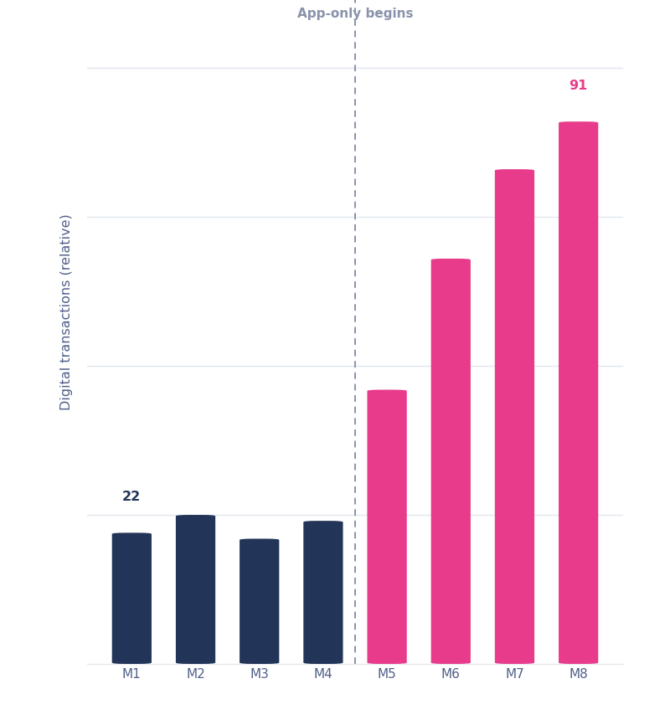
What we can say now, based on the sites we’ve supported through this change, is that the pattern tends to be consistent: digital payment usage climbs quickly once app-only becomes the only option, because drivers adapt faster than most site owners expect. The bigger shift isn’t in persuading people to use the app — it’s in giving them a reason to, by making it the simplest way to pay rather than one option among several. NB: The data shown here is just for illustrative purposes only.
A better experience for every driver
It’s worth remembering that this decision doesn’t just affect how your site runs behind the scenes, it changes what it’s actually like to park there. A driver who’s just spent ten minutes finding a space doesn’t want to then spend another two hunting for change or queuing at a machine that’s only accepting cards “sometimes.”
Paying by app takes seconds, works the same way every time, and gives them a receipt without them having to ask for one. That matters more for some drivers than others, and it’s a fair question to ask before you migrate: what about customers who aren’t confident with apps, or who’ve always used the kiosk out of habit?
It’s a real consideration, not one to wave away. The sites that get this right treat it as part of the plan rather than an afterthought — clear signage, simple instructions, and support in place before the kiosk goes, not after. Done properly, the result is a car park that’s genuinely easier to use for most drivers, and one where the small number who need a bit more help actually get it.
We are ready when you are
None of this has to happen overnight, and it isn’t a decision you’re expected to make alone. If your site is one of the ones affected by a council’s move away from kiosks, or you’re simply looking at the running costs and thinking there has to be a better way, it’s worth a conversation before anything is scheduled. We’ll walk you through what changes, what stays the same, what the customer experience looks like on day one, and what support is in place if anything needs attention once the kiosk is gone.
The shift from meters and kiosks to app-only payment isn’t really about chasing something new for its own sake. It’s about removing the parts of running a car park that were never adding much value in the first place, and replacing them with something that costs less, breaks less, and gives drivers a better reason to come back. If that sounds like where your site is heading anyway, we’re ready whenever you are.
The questions most site owners ask first
Won’t switching disrupt things for a while?
It shouldn’t, if it’s planned properly. The digital payment option is live and tested before the kiosk is removed, not after, so there’s no gap where drivers can’t pay at all. Signage goes up on day one, and usage is watched closely in the first couple of weeks so anything unexpected gets picked up quickly
What about customers who don’t want to use an app?
This is the question we take most seriously, and it’s a fair one. Not every driver is comfortable with a new way of paying, and pretending otherwise doesn’t help anyone. The answer is clear signage, simple instructions, and extra support built into the plan for sites where it’s likely to matter more , not assuming everyone will just work it out.
Does this mean giving something up commercially?
For most sites, it’s the opposite. You’re not swapping one payment method for a worse one; you’re removing a piece of equipment that cost money to run and occasionally stopped taking payments altogether. The digital option is simpler to maintain and, because it doesn’t break down the way a mechanical kiosk eventually does, it tends to be more reliable, not less.
How long does the whole process take?
It varies by site, but it’s never a single overnight switch. There’s a planning stage first, confirming the digital payment route, agreeing a date, getting signage ready before anything physical changes. You’ll know what’s happening and when, well before it happens.